The Metaverse Was Built for the Wrong User: Why Spatial AI Is the Next Platform Shift
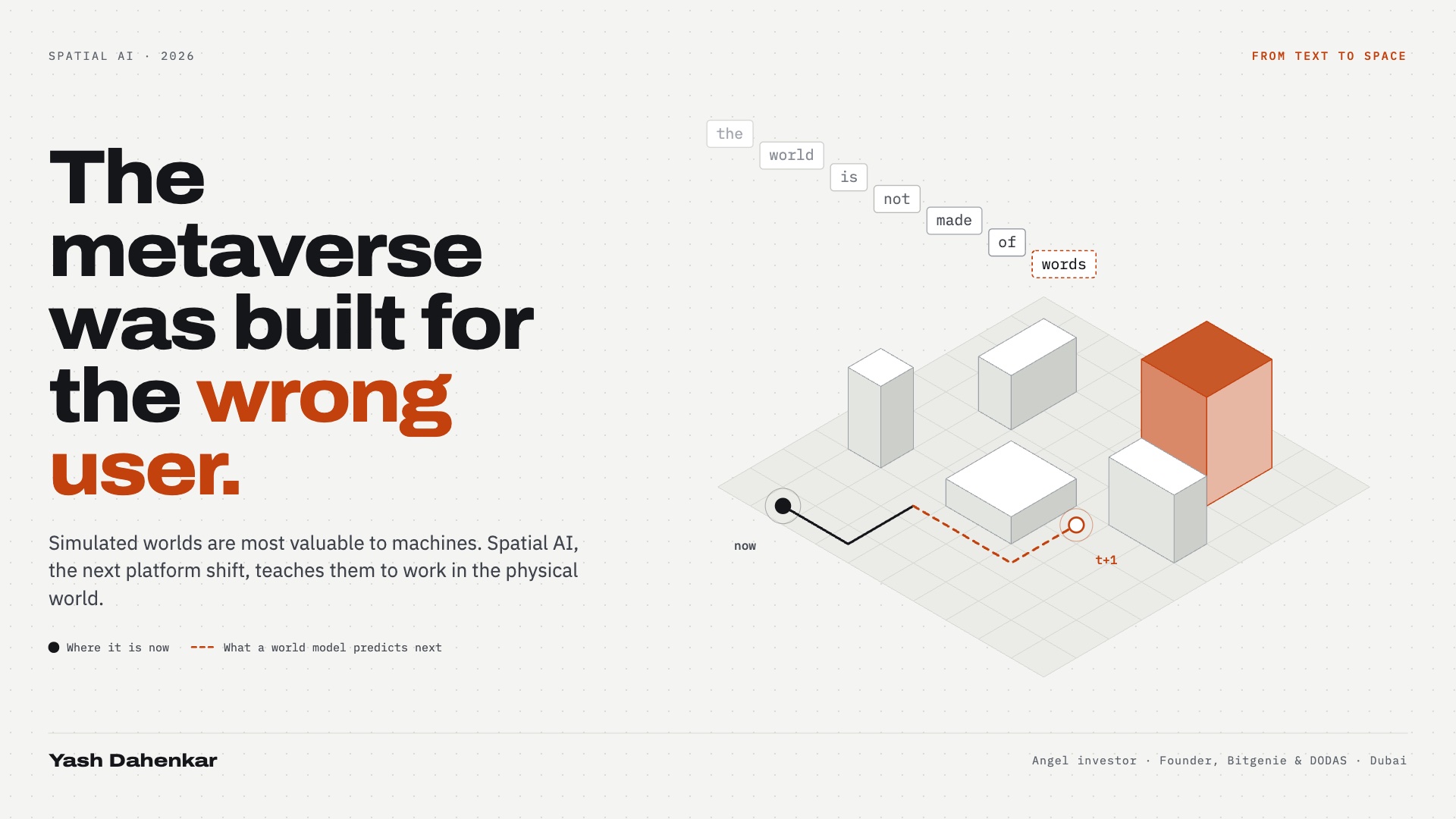
AMD's $8.2 billion deal for World Labs shows where AI is heading next. Angel investor Yash Dahenkar argues that simulated worlds are most valuable to machines, and that spatial AI, not language, is the next platform shift.
By Yash Dahenkar · Guest column · Edited by Neha Soni
Published · 6 min read
Opinion: this is a guest column. The views are the author's own and are not CoinGeography's. It is not financial advice.
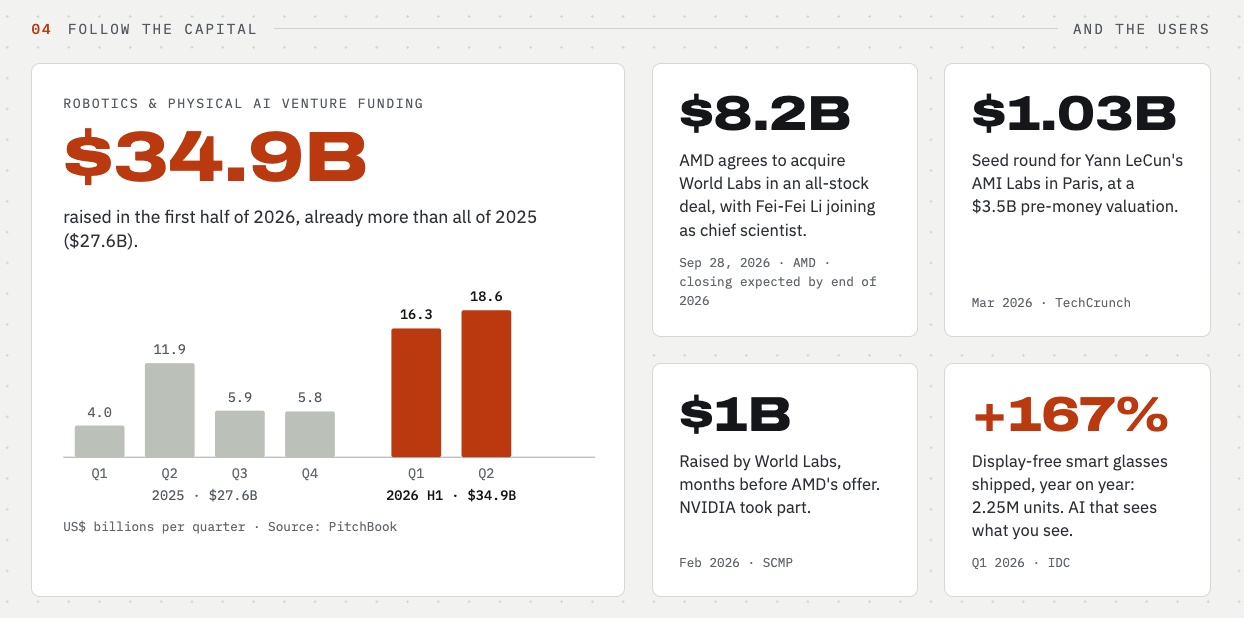
In the space of four weeks this autumn, the AI industry showed us where it is heading next. On 1 September, World Labs, the startup co-founded by Stanford's Fei-Fei Li, released Atlas, a single model that can generate, reconstruct and simulate 3D worlds. On 28 September, AMD agreed to acquire World Labs in an all-stock deal valued at about $8.2 billion, with Li set to join AMD as chief scientist.
A chipmaker paying billions for a lab of roughly 70 people is not buying a product. It is buying a view of the workload its chips will have to serve years from now. That workload is spatial: AI that understands, predicts and acts in three-dimensional space.
I have spent nine years building and investing at the edge of AI and virtual worlds. My conviction is simple. Language was the first act of the generative AI era. Space is the second, and it will be bigger, slower and harder than the first.
Language was the easy part
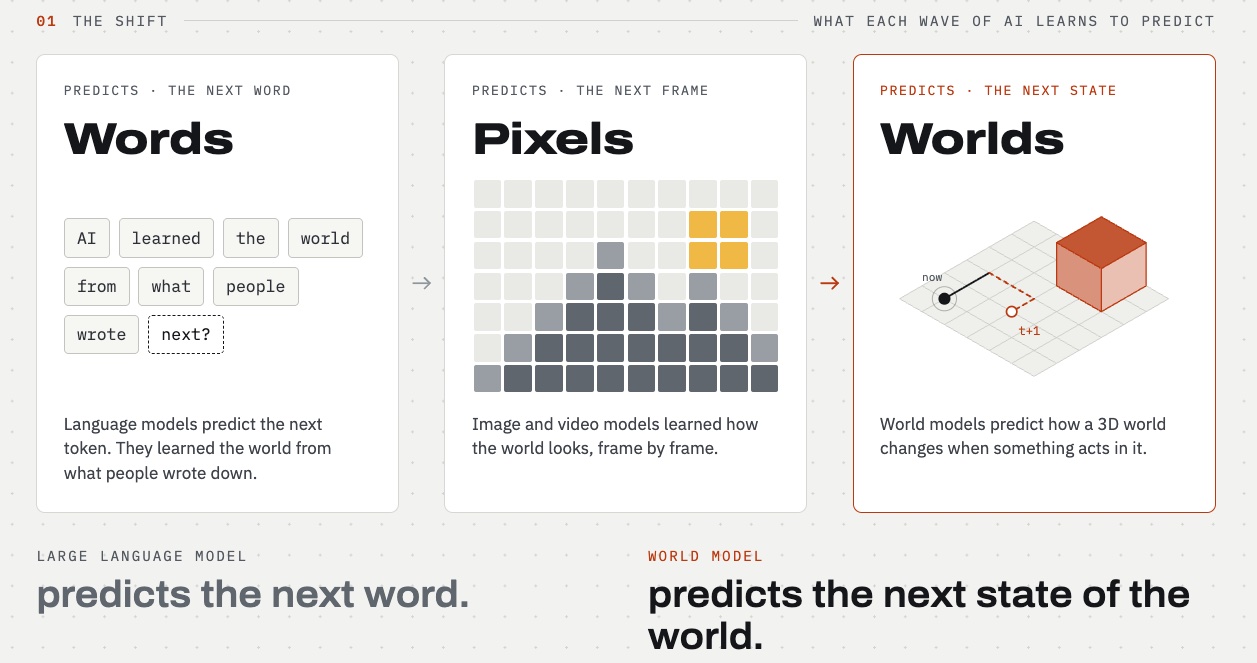
Large language models learned about the world through the text humans wrote about it. That was an extraordinary shortcut, and it has limits. In her November 2025 essay "From Words to Worlds", Li pointed out that today's best multimodal models seldom beat chance when asked to judge distance, orientation or size.
Roboticists call this Moravec's paradox. What is hard for people, such as calculus, is easy for machines. What a toddler does without thinking, such as stacking cups, remains hard.
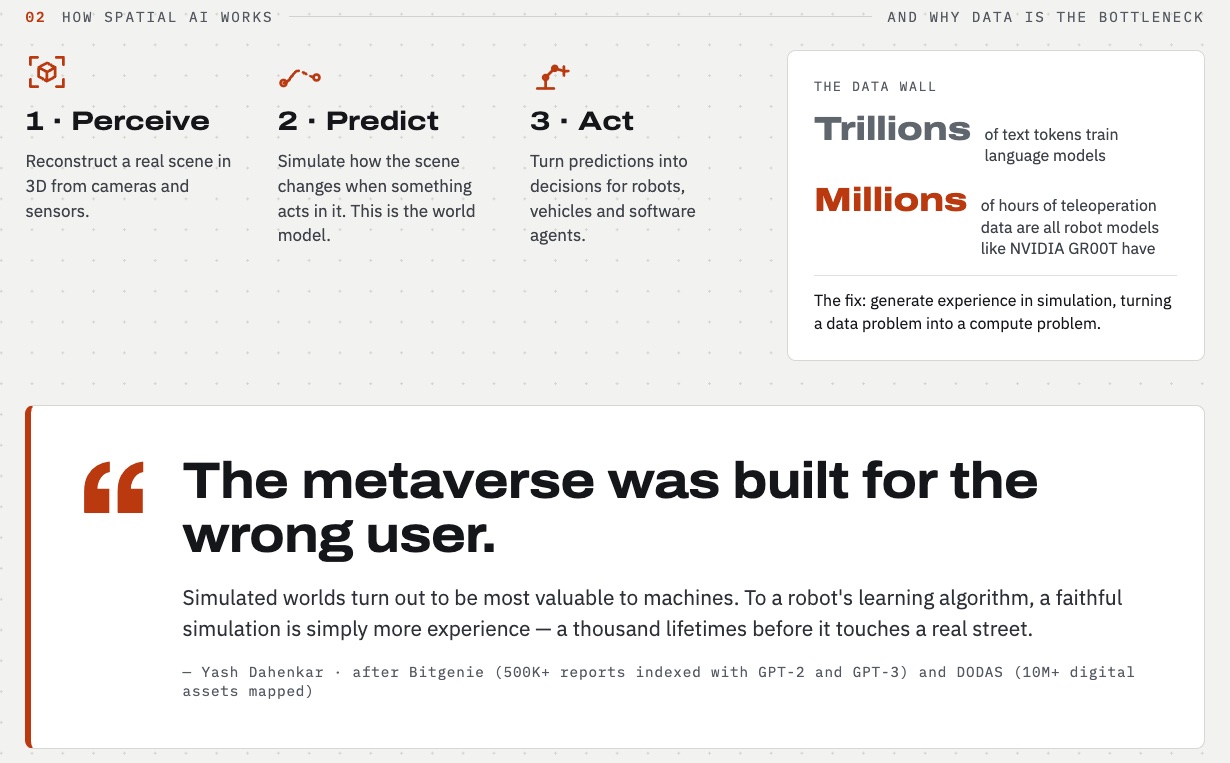
Spatial AI is the attempt to close that gap. In practice it rests on three capabilities:
- Perceive: reconstruct a real scene in 3D from cameras and sensors.
- Predict: simulate how that scene changes when something, or someone, acts in it. This is what the field now calls a world model.
- Act: turn those predictions into decisions for a robot, a vehicle or a software agent.
An LLM (large language model) predicts the next word. A world model predicts the next state of the world. That one change of target explains why the frontier labs are moving into world models.
The metaverse was built for the wrong user
I reached this view through my experience of building two successful companies.
In 2017, I founded Bitgenie. We used GPT-2 in 2019 and GPT-3 in 2020 to index more than 500,000 market research reports without human intervention. The system summarised each report and extracted its charts and data. It taught me early what language models are superb at: compressing what people have already written down. It also showed me what they never see, which is everything nobody wrote down.
#spatial AI#world models#metaverse#World Labs#AMD#physical AI
Corrections
No corrections have been issued for this article.
Spotted an error? See our editorial and corrections policy or contact us.
Information only — not financial advice.